Filter by
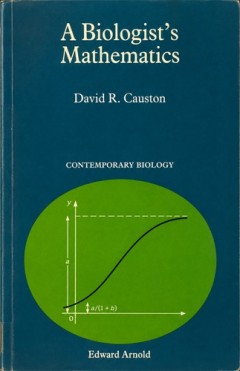
A Biologist’s Mathematics
A student text presenting mathematical ideas and methods in biological research. Part of the Contemporary Biology series, published by Edward Arnold in 1977.
- Edition
- Not specified
- ISBN/ISSN
- 0-7131-2605-1
- Collation
- -
- Series Title
- Contemporary Biology
- Call Number
- 510 C374
A Biologist's Mathematics
A Biologist's Mathematics introduces mathematical concepts specifically tailored for biologists, emphasizing clarity, precision, and practical application rather than abstract mathematical theory. The book explains why mathematics is an essential language for biology, particularly for describing data quantitatively, formulating models, and testing biological hypotheses. Causton begins with fou…
- Edition
- 1st
- ISBN/ISSN
- 0713126043
- Collation
- -
- Series Title
- -
- Call Number
- 574,0151 C374
Biomathematics and Related Computational Problems
This volume is a collection of peer‑reviewed research papers selected from the International Workshop on Biomathematics and Related Computational Problems, held in Naples and Anacapri, Italy, in May 1987. The book reflects the rapid development of biomathematics as an interdisciplinary field, integrating mathematics, biology, neuroscience, and computational modeling. Topics covered include n…
- Edition
- 1st
- ISBN/ISSN
- 9027727260
- Collation
- -
- Series Title
- -
- Call Number
- 574.015 B615

Lectures on Mathematics in the Life Sciences: Some Mathematical Questions in …
A collection of lectures exploring mathematical approaches to biological problems, including modeling, population dynamics, and quantitative analysis in life sciences.
- Edition
- -
- ISBN/ISSN
- -
- Collation
- x + 150 pages : illustrations ; 23 cm (approx.)
- Series Title
- -
- Call Number
- 574.51 S989
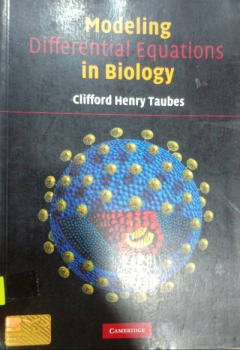
Modeling Differential Equations in Biology
This book introduces the use of differential equations to model biological phenomena. It covers population dynamics, epidemiology, biochemical kinetics, and other applications of ordinary and partial differential equations in biological systems. Suitable for undergraduate and graduate students in mathematics, biology, and applied sciences.
- Edition
- 1st edition
- ISBN/ISSN
- 978-0-521-70843-2
- Collation
- Approx. 250 pages
- Series Title
- -
- Call Number
- -
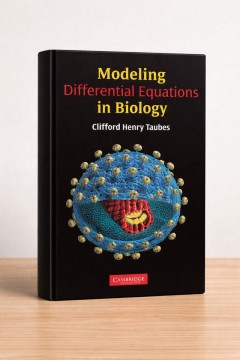
Modeling Differential Equations in Biology
This textbook teaches how differential equations are used in the biological sciences. It is based on a successful one-semester course and helps students in life sciences understand differential equations in real biological contexts. The text introduces necessary mathematics — such as linear algebra and partial differential equations — when and where needed, using examples drawn from real …
- Edition
- -
- ISBN/ISSN
- 978-0-521-70843-2
- Collation
- 500 pages;
- Series Title
- -
- Call Number
- 570.151 T28
 Computer Science, Information & General Works
  Philosophy & Psychology
  Religion
  Social Sciences
  Language
  Pure Science
  Applied Sciences
  Art & Recreation
  Literature
  History & Geography