Filter by
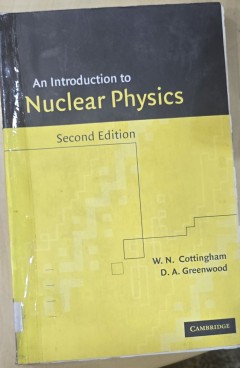
Nuclear Physics
This textbook provides a clear and concise introduction to nuclear physics, covering topics such as nuclear structure, radioactive decay, and nuclear reactions. The second edition includes updates in particle physics and applications of nuclear physics, making it ideal for undergraduate students in physics and related disciplines. The authors combine theoretical insights with practical examples…
- Edition
- 2nd Edition
- ISBN/ISSN
- 0-521-65733-4
- Collation
- xiii, 271 pages : illustrations ; 25 cm
- Series Title
- [None, unless specified by your system]
- Call Number
- -

The Origin of the Concept of Nuclear Forces
This book offers a historical account of the development of the concept of nuclear forces, tracing the emergence of theories that explain the interactions between nucleons in atomic nuclei. The authors, both physicists and historians of science, explore key milestones and the contributions of major figures in nuclear physics, providing insight into the theoretical and experimental challenges th…
- Edition
- [Leave blank if not specified]
- ISBN/ISSN
- 0-7503-0373-5
- Collation
- x, 113 pages : illustrations ; 24 cm
- Series Title
- x, 113 pages : illustrations ; 24 cm
- Call Number
- Nuclear forces Nuclear physics — History Theoret

High-Energy Particle Diffraction
This book provides a comprehensive and detailed account of the theory of high-energy particle diffraction. It addresses the theoretical underpinnings of diffraction phenomena involving hadrons at high energies and their applications in particle and nuclear physics. The content ranges from basic principles to advanced theoretical developments, making it suitable for researchers and graduate stud…
- Edition
- [Leave blank if not specified]
- ISBN/ISSN
- 3-540-4210706
- Collation
- xiii, 398 pages : illustrations ; 24 cm
- Series Title
- texts and Monographs in Physics
- Call Number
- [Leave blank if not available]
A Textbook of Biophysics
Comprehensive textbook covering fundamentals of biophysics, including key subjects such as thermodynamics, solutions, colloids, nuclear medicine, membrane biophysics, instrumentation, chronobiology, biomagnetism, biomedical techniques, and biophysical applications in physiology and medicine. Designed for undergraduate and postgraduate students in medical and life sciences, as well as biomedical…
- Edition
- 2nd Edition (Revised/Reprint); originally publishe
- ISBN/ISSN
- -
- Collation
- -
- Series Title
- -
- Call Number
- 574,191 R888
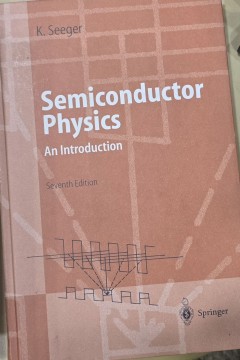
Semiconductor Physics: An Introduction
This well-established textbook gives a comprehensive introduction to the basic principles of semiconductor physics and includes up-to-date topics such as quantum structures, optoelectronic devices, and high-frequency transistors. Designed for graduate and advanced undergraduate students, it covers both theoretical and experimental aspects with illustrative problems and solutions at the end of e…
- Edition
- 9th Revised and Updated Edition
- ISBN/ISSN
- 3-540-65786-x
- Collation
- xii, 561 pages : illustrations ; 24 cm
- Series Title
- Springer Series in Solid-State Sciences ; Vol. 45
- Call Number
- -
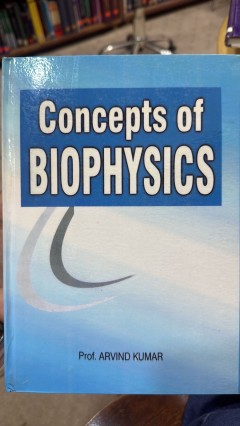
Concepts of Biophysics
A comprehensive introductory text on the quantitative and physical aspects of biological structures and processes. Designed for students and professionals in biology, physics, medicine, and allied sciences, it presents biophysical concepts with clarity and logical explanation. Includes research-based chapters and practical examples to demystify complex topics
- Edition
- 1st Edition
- ISBN/ISSN
- 8176489220
- Collation
- -
- Series Title
- -
- Call Number
- 574,191 K95

Electronic Structure of Alloys, Surfaces and Clusters
This book offers a comprehensive treatment of the electronic properties of materials with emphasis on alloys, surfaces, and nanoclusters. It includes modern theoretical approaches such as density functional theory and many-body perturbation methods. Suitable for graduate students and researchers in physics and materials science.
- Edition
- 1st Edition
- ISBN/ISSN
- 0-5415-27249-1
- Collation
- xvi, 528 pages: illustrations; 24 cm
- Series Title
- Cambridge Studies in Magnetism
- Call Number
- 539.7

Theory of the Electron: A Theory of Matter from Start
In this book, Jaime Keller presents a novel theory of the electron, aiming to develop a new conceptual foundation for matter starting from first principles. Combining elements of theoretical physics, quantum mechanics, and field theory, this work is intended for researchers and advanced students interested in foundational questions of matter and particles.
- Edition
- 1st Edition
- ISBN/ISSN
- 0-7923-6819-3
- Collation
- xii, 245 pages; 23 cm
- Series Title
- None]
- Call Number
- : 530.1 KEL
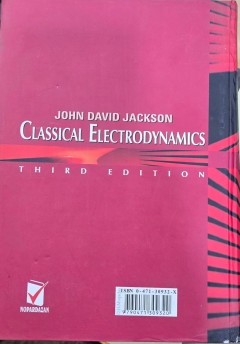
Classical Electrodynamics
- Edition
- 3rd Edition
- ISBN/ISSN
- -
- Collation
- xix, 808 pages: illustrations; 25 cm
- Series Title
- Wiley Classics Library (optional – sometimes listed as part of this series)
- Call Number
- 537.6 JAC
- Edition
- 3rd Edition
- ISBN/ISSN
- -
- Collation
- xix, 808 pages: illustrations; 25 cm
- Series Title
- Wiley Classics Library (optional – sometimes listed as part of this series)
- Call Number
- 537.6 JAC

Multiple Scattering in Solids
This book presents a comprehensive treatment of multiple scattering theory, its formalism, and applications to solid-state physics. Emphasizing electronic structure and the use of Green’s functions, it is intended for researchers and advanced students in condensed matter physics and materials science
- Edition
- 1st Edition
- ISBN/ISSN
- 0-387-98853-X
- Collation
- xvii, 344 pages: illustrations; 24 cm
- Series Title
- :Springer Series in Solid-State Sciences
- Call Number
- : 530.41 (Physics of matter – solids)
 Computer Science, Information & General Works
  Philosophy & Psychology
  Religion
  Social Sciences
  Language
  Pure Science
  Applied Sciences
  Art & Recreation
  Literature
  History & Geography