Filter by
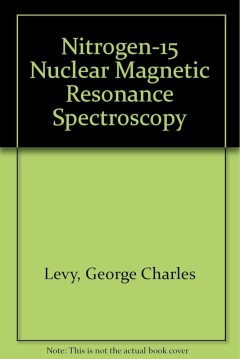
Nitrogen-15 nuclear magnetic resonance spectroscopy
This book is a specialized monograph on the theory and application of nitrogen‑15 (^15N) nuclear magnetic resonance (NMR) spectroscopy, an analytical technique used to investigate molecular structure and dynamics involving the ^15N isotope. It explores the fundamental principles of ^15N NMR, experimental methods, interpretation of chemical shifts and coupling, and practical examples in organi…
- Edition
- -
- ISBN/ISSN
- -
- Collation
- -
- Series Title
- -
- Call Number
- 547.308 L668
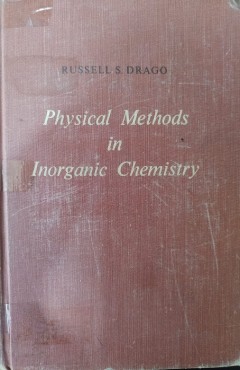
Physical Methods in Inorganic Chemistry
Physical Methods in Inorganic Chemistry by Russell S. Drago is a definitive, high-level guide to the spectroscopic and theoretical tools used to analyze inorganic molecules. Moving beyond purely descriptive chemistry, the text bridges the gap between theoretical physical principles and practical laboratory applications.
- Edition
- First edition
- ISBN/ISSN
- -
- Collation
- -
- Series Title
- -
- Call Number
- 541.2 D759
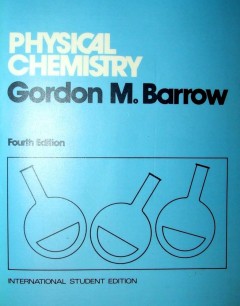
Physical Chemistry
Gordon M. Barrow’s Physical Chemistry (Fourth Edition) remains a staple for undergraduate students worldwide. Known for its clear, step-by-step explanations, this International Student Edition masterfully bridges the gap between complex mathematical concepts and practical chemical applications. Covering thermodynamics, quantum mechanics, kinetics, and molecular structure, Barrow uses intuitiv…
- Edition
- Fourth edition
- ISBN/ISSN
- -
- Collation
- -
- Series Title
- -
- Call Number
- 541.3 B278

stereochemical applications of NMR studies in rigid bicyclic system
This volume focuses on the application of nuclear magnetic resonance (NMR) spectroscopy to determine stereochemical features in rigid bicyclic organic compounds. It explores how chemical shifts and spin–spin coupling patterns in ^1H and ^13C NMR spectra reflect geometric and stereochemical arrangements uniquely present in bicyclic systems such as norbornanes and related structures. By analyzi…
- Edition
- -
- ISBN/ISSN
- -
- Collation
- -
- Series Title
- -
- Call Number
- 547.5046 M315

An introduction to organic chemistry
An Introduction to Organic Chemistry by John Read is an early foundational textbook designed to introduce students to the basics of organic chemistry at a time when the subject was still formalizing its educational approach. The book covers essential concepts such as the structure and properties of organic molecules, simple functional groups, and fundamental reactions, presented in a clear desc…
- Edition
- -
- ISBN/ISSN
- -
- Collation
- -
- Series Title
- -
- Call Number
- 547 K28

An Introduction to Conservation of Orbital Symmetry A Programmed Text
This book introduces the concept of conservation of orbital symmetry in chemical reactions. It explains how the symmetry of molecular orbitals governs whether reactions are allowed or forbidden, especially in pericyclic reactions. The text uses a step-by-step, programmed approach to help students understand orbital interactions, reaction pathways, and stereochemistry. It provides a clear founda…
- Edition
- First edition
- ISBN/ISSN
- -
- Collation
- -
- Series Title
- -
- Call Number
- 541,3 B433

Interpretation of organic spectra edited
Interpretation of Organic Spectra is a specialist reference volume focused on deciphering the results of key spectroscopic techniques used in organic chemistry. Edited by D. W. Mathieson, the book brings together practical examples and discussions illustrating how spectra such as infrared (IR), nuclear magnetic resonance (NMR), and mass spectrometry (MS) can be interpreted to deduce the struc…
- Edition
- -
- ISBN/ISSN
- -
- Collation
- -
- Series Title
- -
- Call Number
- 547.346 I61

Water-soluble synthetic polymers: properties and behavior, volume II
Water‑Soluble Synthetic Polymers: Properties and Behavior, Volume II provides a comprehensive physical‑chemical treatment of synthetic polymers that dissolve in water, examining how molecular structure influences polymer behavior in solution. The volume surveys key topics such as polyelectrolytes, interactions of polymers with small‑molecule cosolutes, polymer–polymer interactions, and …
- Edition
- -
- ISBN/ISSN
- -
- Collation
- -
- Series Title
- -
- Call Number
- 547.13 L921

Physical principles and techniques of protein chemistry, Part B
This volume focuses on the application of physical methods to the study of protein structure and properties, covering a range of specialized analytical techniques. It opens with a detailed treatment of ultracentrifugal analysis and intrinsic viscosity measurements, which are essential for understanding molecular size and interactions in solution. Subsequent chapters examine light scattering, in…
- Edition
- -
- ISBN/ISSN
- -
- Collation
- -
- Series Title
- -
- Call Number
- 547.75 L434

Applications of nuclear magnetic resonance spectroscopy in organic chemistry
This authoritative text presents the principles and practical applications of nuclear magnetic resonance (NMR) spectroscopy in organic chemistry, offering both theoretical foundations and analytical examples. Beginning with a clear introduction to NMR theory and instrumentation, the book explains how nuclear spins interact with magnetic fields and how data are collected. It then delves into the…
- Edition
- 2nd edition
- ISBN/ISSN
- -
- Collation
- -
- Series Title
- -
- Call Number
- 547.3087 J12
 Computer Science, Information & General Works
  Philosophy & Psychology
  Religion
  Social Sciences
  Language
  Pure Science
  Applied Sciences
  Art & Recreation
  Literature
  History & Geography