Filter by

Fundamentals of Applied Dynamics
- Edition
- -
- ISBN/ISSN
- 0-471-10937-1
- Collation
- -
- Series Title
- -
- Call Number
- 620.1/w 664
- Edition
- -
- ISBN/ISSN
- 0-471-10937-1
- Collation
- -
- Series Title
- -
- Call Number
- 620.1/w 664
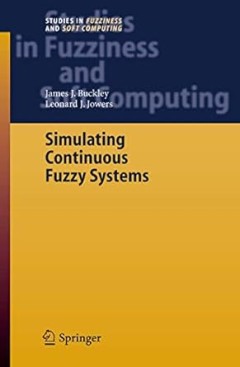
Simulating Continuous Fuzzy Systems
This work is a companion to Simulating Fuzzy Systems (2005), which focused on discrete-event systems, extending those principles to the continuous domain. It targets researchers and advanced practitioners in fuzzy systems, computational intelligence, control theory, and applied mathematics, offering both theoretical exposition and practical simulation strategies with fuzzy uncertainty analysis .
- Edition
- 2006th Edition
- ISBN/ISSN
- 3540284559
- Collation
- -
- Series Title
- -
- Call Number
- 511.322 B924

Return to Paradise
- Edition
- 1st edition
- ISBN/ISSN
- Not applicable
- Collation
- 372
- Series Title
- -
- Call Number
- Novel
- Edition
- 1st edition
- ISBN/ISSN
- Not applicable
- Collation
- 372
- Series Title
- -
- Call Number
- Novel
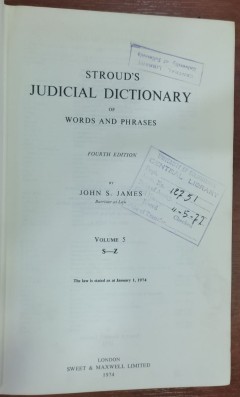
SUDICIAL DICTIONARY
- Edition
- 1
- ISBN/ISSN
- 421143304
- Collation
- -
- Series Title
- -
- Call Number
- -
- Edition
- 1
- ISBN/ISSN
- 421143304
- Collation
- -
- Series Title
- -
- Call Number
- -

FOR JAMES AND GILLIAN JIM GILLS NEW YORK
- Edition
- 1
- ISBN/ISSN
- -
- Collation
- -
- Series Title
- -
- Call Number
- -
- Edition
- 1
- ISBN/ISSN
- -
- Collation
- -
- Series Title
- -
- Call Number
- -

Molecular Biology of the Gene
This foundational textbook provides a comprehensive introduction to the molecular mechanisms of gene function. The fifth edition integrates modern research on genomics, transcriptional control, and molecular structure, making it ideal for advanced undergraduate and graduate-level courses
- Edition
- Fifth Edition
- ISBN/ISSN
- 0805346422
- Collation
- -
- Series Title
- -
- Call Number
- 5728 W338

Chemical Measurements in Biological Systems
This book focuses on analytical methods for measuring chemical substances in biological systems. It provides insight into techniques such as electrochemical sensors, spectrophotometry, chromatography, and their application to physiological and biochemical research.
- Edition
- First Edition
- ISBN/ISSN
- 0471139033
- Collation
- -
- Series Title
- -
- Call Number
- 572,36 S849
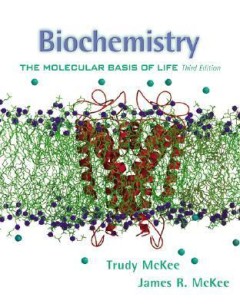
Biochemistry: The Molecular Basis of Life
This textbook presents biochemistry in the context of the human body and disease, emphasizing the molecular basis of life processes. The third edition integrates new scientific advances, such as genomics and proteomics, and provides case studies, illustrations, and end-of-chapter problems suitable for students in life sciences and health fields
- Edition
- Third Edition
- ISBN/ISSN
- 007231592
- Collation
- -
- Series Title
- -
- Call Number
- 572 M479
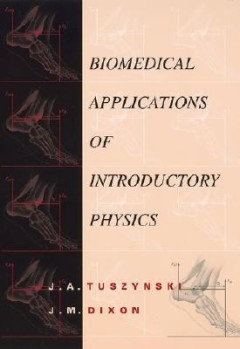
Biomedical Applications for Introductory Physics
A textbook that introduces foundational physics concepts through biomedical contexts. Designed for students in life sciences and allied health fields. Covers mechanics, fluids, thermodynamics, waves, electricity, and magnetism, with applied problems and case studies in human physiology and medicine.
- Edition
- 1st edition
- ISBN/ISSN
- 0471412953
- Collation
- -
- Series Title
- -
- Call Number
- 571,4 T964

Chemistry: A World of Choices
This textbook integrates chemical principles with real-world applications. It explores how chemistry is used in decisions about health, environment, and industry. Designed for students in general chemistry courses, with an emphasis on informed choices.
- Edition
- 2nd Edition
- ISBN/ISSN
- 0-07-119937-3
- Collation
- xxvi, 984 pages : color illustrations ; 28 cm
- Series Title
- -
- Call Number
- 540 K29
 Computer Science, Information & General Works
  Philosophy & Psychology
  Religion
  Social Sciences
  Language
  Pure Science
  Applied Sciences
  Art & Recreation
  Literature
  History & Geography