Filter by
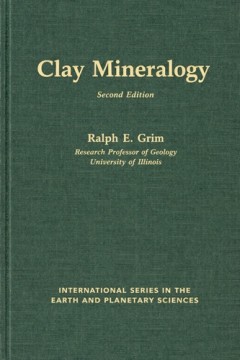
Clay Mineralogy
This book provides a comprehensive study of clay minerals, including their structure, composition, properties, and applications in geology and related sciences. It serves as a foundational reference for students and researchers in mineralogy and earth sciences.
- Edition
- Second Edition
- ISBN/ISSN
- -
- Collation
- -
- Series Title
- International Series in the Earth and Planetary Sciences
- Call Number
- 549.1145 G861
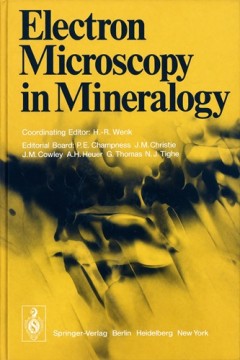
Electron Microscopy in Mineralogy
This book introduces the use of electron microscopy in mineralogical research, emphasizing microstructure analysis of minerals and rocks. It covers transmission electron microscopy (TEM) and includes emerging applications of scanning electron microscopy (SEM), serving both as an introductory text and a reference for advanced study.
- Edition
- Not specified
- ISBN/ISSN
- 3-540-07371-X
- Collation
- -
- Series Title
- Not specified
- Call Number
- 549.133 E38
Optical Mineralogy: Mineral Descriptions (Volume 2)
This volume provides detailed descriptions of minerals with emphasis on their optical properties, intended for use in mineralogy and geology studies, especially in petrographic analysis.
- Edition
- Volume 2
- ISBN/ISSN
- 0-86534-325-5 (Vol. 2)
- Collation
- -
- Series Title
- Not specified
- Call Number
- 549.125 E33
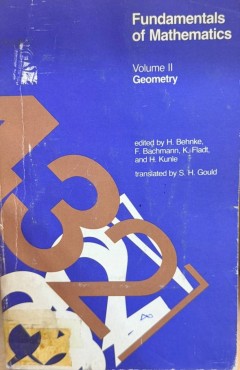
Fundamentals of Mathematics. Volume II: Geometry
A comprehensive treatment of Geometry, covering classical and modern topics with rigorous exposition, intended for advanced students.
- Edition
- First MIT Press paperback edition
- ISBN/ISSN
- 0-262-52094-X
- Collation
- xvi, 500 pages : illustrations ; 24 cm
- Series Title
- Fundamentals of Mathematics ; volume II
- Call Number
- 516 F 981

Foundations of Geometry: Selected Proceedings of a Conference
This volume contains selected papers from a conference held at the University of Toronto (1974), focusing on foundational issues in Geometry, including axiomatic systems and logical structures.
- Edition
- First Edition
- ISBN/ISSN
- 0-8020-2216-2
- Collation
- x, 250 pages : illustrations ; 24 cm
- Series Title
- -
- Call Number
- 516 F 764
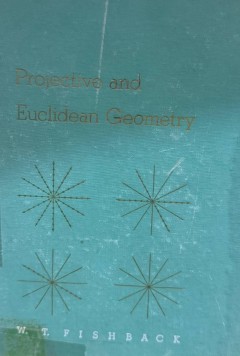
Projective and Euclidean Geometry
This book presents the fundamental principles of both projective and Euclidean geometry, highlighting their relationships and differences. It is suitable for students seeking a solid foundation in Geometry, with emphasis on structure, proofs, and geometric reasoning.
- Edition
- -
- ISBN/ISSN
- 62-20162
- Collation
- x, 350 pages : illustrations ; 24 cm
- Series Title
- [Not part of a series]
- Call Number
- 516.2 F 532
A Scrapbook of Complex Curve Theory
An informal and insightful introduction to complex algebraic curves, emphasizing geometric intuition and examples. The book explores key ideas in Algebraic Geometry, including theta functions and Jacobian varieties.
- Edition
- First Edition
- ISBN/ISSN
- 0-306-40536-9
- Collation
- xii, 186 pages : illustrations ; 24 cm
- Series Title
- The University Series in Mathematics
- Call Number
- 516.35 C 625
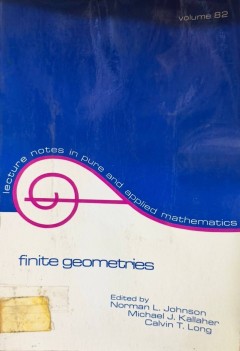
Finite Geometries
This volume contains research papers presented at a conference honoring T. G. Ostrom, focusing on developments in Finite Geometry. Topics include combinatorial structures, projective planes, and applications of finite geometric methods.
- Edition
- First Edition
- ISBN/ISSN
- -
- Collation
- xii, 420 pages : illustrations ; 24 cm
- Series Title
- Lecture Notes in Pure and Applied Mathematics ; v. 82
- Call Number
- 516 F498

Foundations of Euclidean and Non-Euclidean Geometry
This book provides a rigorous introduction to the foundations of both Euclidean and non-Euclidean geometry. Richard L. Faber develops the axiomatic structure of geometric systems and examines the differences between classical Euclidean geometry and alternative geometries. The text is suitable for advanced students and focuses on logical reasoning, proofs, and the theoretical basis of Geometry.
- Edition
- First Edition
- ISBN/ISSN
- 0-8247-1748-1
- Collation
- xii, 388 pages : illustrations ; 24 cm
- Series Title
- [Not part of a series]
- Call Number
- 516 F 115

Modern Geometry—Methods and Applications. Part II. The Geometry and Topolog…
This volume is part of a comprehensive series on modern geometry, focusing on the geometry and topology of manifolds. The authors develop fundamental concepts of Differential Geometry and Topology, including smooth manifolds, vector fields, and global geometric structures. The book combines rigorous theory with applications, making it an important resource for advanced students and researchers …
- Edition
- [Not specified]
- ISBN/ISSN
- 0-387-96162-3
- Collation
- xii, 430 pages : illustrations ; 24 cm
- Series Title
- Modern Geometry—Methods and Applications ; Part II
- Call Number
- 516 D 819
 Computer Science, Information & General Works
  Philosophy & Psychology
  Religion
  Social Sciences
  Language
  Pure Science
  Applied Sciences
  Art & Recreation
  Literature
  History & Geography